
Acrylic vs mesh bathroom drawer organizers compared
Ads
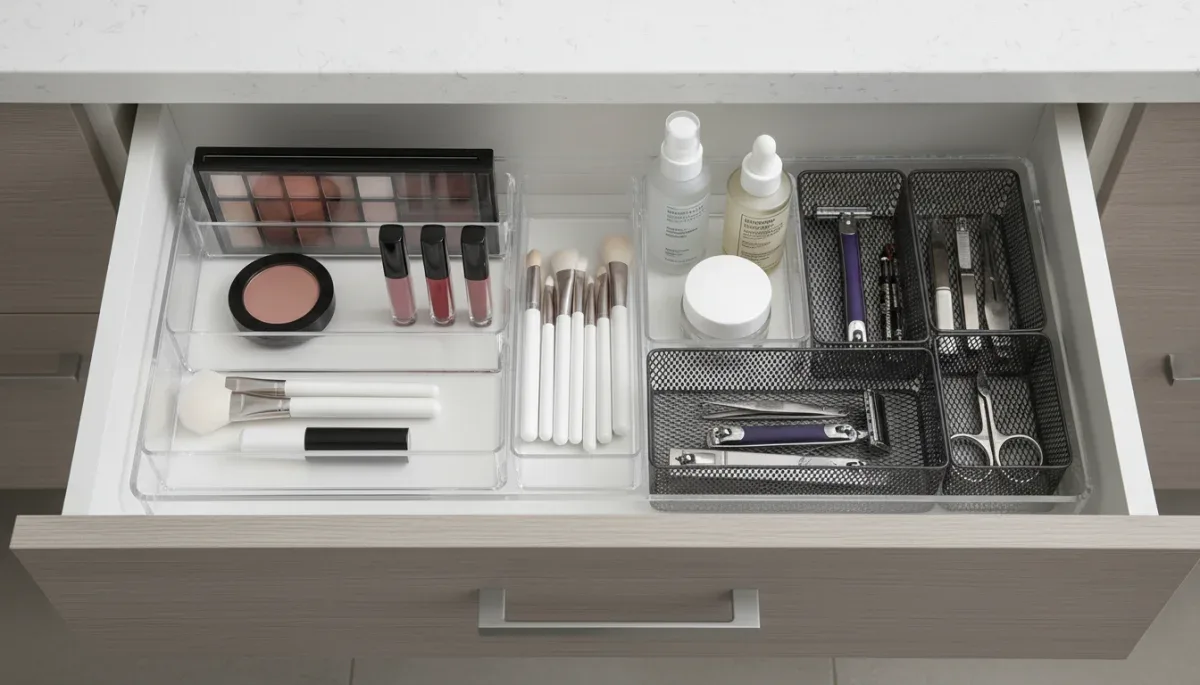
Acrylic organizers protect bathroom vanity drawers from cosmetic leaks and wet countertops, whereas powder-coated wire mesh bins provide continuous ventilation for damp grooming accessories. Deciding between these two common drawer storage materials depends on whether your daily routine involves liquid foundations and oily serums or warm styling tools and damp nail implements.
Ads
This comparison helps homeowners and renters organize shallow or deep vanity cabinets without wasting money on containers that crack, rust, or scratch delicate cabinetry finishes. The main trade-off is straightforward: solid clear plastic creates an impermeable barrier against spills but shows every smudge of powder, while open metal mesh sheds loose residue but permits liquids to seep directly onto your drawer liner.
Ads
Material construction and moisture resistance
Bathroom environments experience frequent shifts in ambient humidity, warm steam from showers, and direct contact with water from nearby sinks. The chemical composition of your bathroom drawer organizers dictates how well they withstand these conditions over several years of continuous use. Acrylic storage units are molded from rigid poly(methyl methacrylate) or durable polystyrene plastic. These non-porous thermoplastics do not absorb atmospheric moisture, swell when exposed to water droplets, or degrade under typical indoor temperature fluctuations. Because the base of an acrylic tray is a solid sheet, any spilled micellar water, liquid soap, or toner remains contained inside the insert rather than soaking into the unfinished plywood or composite particle board of your vanity drawer box.
Mesh organizers are fabricated from thin steel or iron wire woven or punched into a perforated diamond or square pattern, then dipped or sprayed with an epoxy or polyester powder coating. Under normal circumstances, this bonded exterior coating shields the underlying ferrous metal from atmospheric oxidation. However, vanities generate an aggressive microclimate. When you place wet makeup sponges, damp toothbrushes, or dripping razors into a mesh basket, moisture collects at the intersections where the horizontal and vertical wire strands cross. If the factory powder coating has microscopic pinholes or suffers chipping from dropping sharp tweezers, water reaches the raw steel core, creating rust spots that permanently stain vanity interiors.
Selecting organizers based on moisture exposure
- High-humidity master baths: Choose clear molded acrylic bins when the vanity sits within four feet of an enclosed shower stall without commercial-grade exhaust ventilation.
- Powder rooms and half baths: Use powder-coated wire mesh freely where showers do not produce regular steam cycles or elevated humidity levels.
- Sink splash zones: Install solid acrylic trays in the upper drawers directly below vessel sinks where pipe fittings or countertop runoff might leak downward.
- Secondary storage cabinets: Employ coated steel mesh in tall linen towers where ambient air circulates freely and stored items remain completely dry.
Cleaning routines and stain defense
Daily grooming leaves behind a trail of cosmetic debris, stray hairs, tooth polish mist, and liquid foundation fingerprints. Maintaining sanitary storage requires knowing how each material reacts to standard household cleaning agents and mechanical scrubbing. Acrylic organizers offer a completely smooth, continuous surface area that you can wipe down with a microfiber towel in seconds. Liquid spills do not seep through seams, making it simple to lift a single modular bin out of the vanity, rinse it under lukewarm sink water, and dry it with a soft cloth before returning it to its designated spot.
The drawback of clear acrylic is its vulnerability to surface scratching and chemical clouding. Acrylic is a relatively soft polymer with low scratch resistance. Dragging metal tweezers, manicure scissors, or coarse emery boards across an acrylic tray creates micro-abrasions that scatter light and make the tray look dull over time. Furthermore, common bathroom cleaning chemicals like rubbing alcohol, acetone nail polish remover, and ammonia-based glass sprays cause acrylic to craze, forming thousands of tiny internal fractures that ruin transparency and weaken the plastic wall structure.
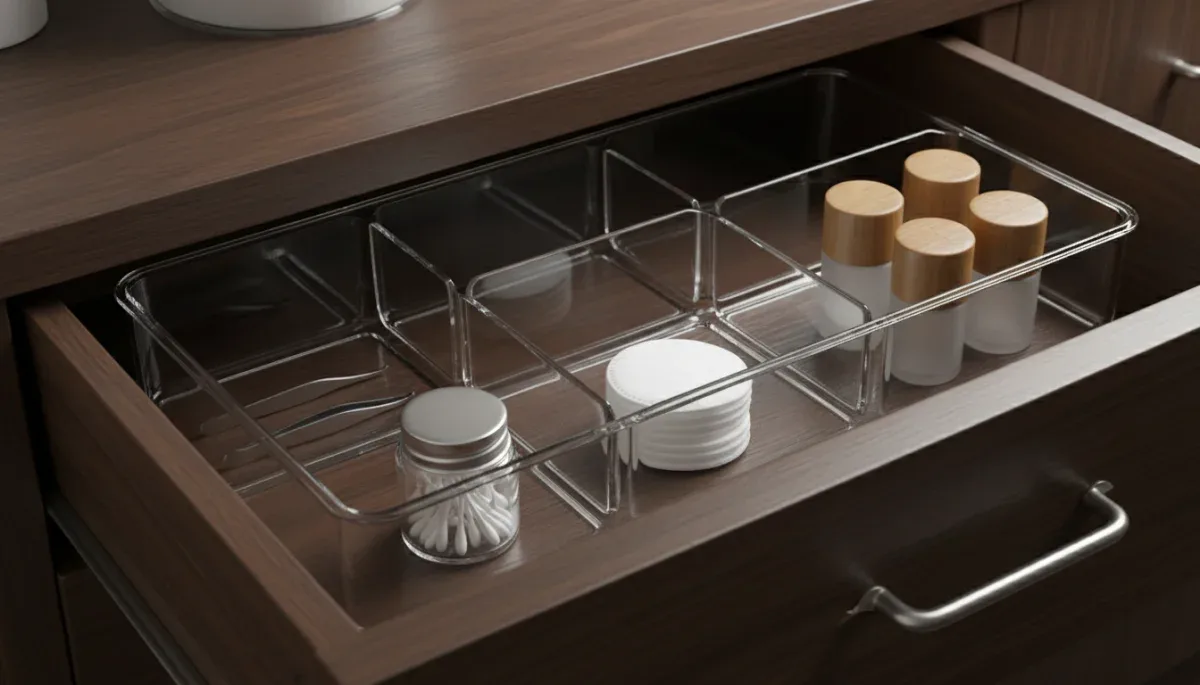
Cleaning wire mesh requires a completely different approach due to its textured, open-grid geometry. Fine cosmetic powders, such as bronzer, setting powder, and dry shampoo dust, fall straight through the openings of the mesh grid rather than accumulating inside the compartment. This keeps your tools sitting above loose particulate matter. However, when liquid foundation or hair oil mixes with this loose dust, it forms a sticky sludge that coats the individual wire joints. Removing grime from a mesh organizer requires soaking the entire basket in warm soapy water and scrubbing the tiny holes with a soft-bristled brush, which adds considerable time to routine bathroom cleaning sessions.
Visibility and visual weight inside vanity drawers
Clear acrylic and dark or metallic mesh influence the perceived scale and cleanliness of your vanity drawers in contrasting ways. Acrylic has an optical clarity comparable to glass, permitting up to ninety-two percent of visible light to pass through its walls. When you pull open a vanity drawer outfitted with clear modular inserts, you can read labels through the bin dividers, track small items like bobby pins or safety pins settled in the bottom corners, and identify product silhouettes without lifting adjacent containers. This optical transparency makes narrow, shallow drawers appear less congested, creating an open aesthetic that complements minimalist bathroom design.
Despite its clean appearance, acrylic displays every imperfection. Hair strands, oily fingerprint smudges, mascara smudges, and stray droplets of tinted moisturizer contrast sharply against the transparent surface. An acrylic drawer system requires frequent spot maintenance if you dislike seeing visual residue between full vanity overhauls. If you keep items of widely differing packaging colors and sizes in one acrylic bin, the lack of visual boundaries can occasionally make the drawer look busier than intended.
Wire mesh organizers, commonly sold in matte black, silver, graphite, or rose gold finishes, create distinct visual zones inside the drawer box. The geometric pattern of the wire grid obscures minor scuffs, dust specks, and small makeup stains, keeping the interior looking organized between deep cleaning schedules. The opaque frame lines provide a grounded, structured presentation that resembles professional office desk trays or industrial fixtures. However, dark mesh blocks lateral sightlines; you cannot read product labels through the side walls of deep mesh baskets, meaning you must view items directly from an overhead angle to locate small accessories.
Managing daily visual clutter
- Direct line-of-sight storage: Place clear acrylic containers in shallow top drawers where you look directly down at flat items like eye pencils, lipsticks, and dental floss.
- Concealed lower tiers: Reserve darker wire mesh trays for deeper bottom drawers where bulky hairbrushes, electric shavers, and spare lotion pumps create visual noise.
- Color-coordinated setups: Match matte black mesh frames with modern matte black vanity hardware, or choose polished acrylic to align with chrome and polished nickel faucets.
- High-contrast accessories: Store light-colored sponges and white cotton rounds inside dark mesh to make individual grooming staples stand out immediately.
Modular flexibility and physical dimensions
Vanity drawers vary widely across furniture brands, often featuring unconventional widths, shallow depths, and interior cutouts designed to clear P-trap drainpipes and water supply lines. The dimensions and modularity of your organizer collection determine whether you utilize every square inch or end up with awkward, unusable empty margins along the drawer perimeter. Acrylic organizers are predominantly sold as open-stock individual modular bricks or multi-piece matched sets. Manufacturers produce these containers in standardized geometric increments, such as three-by-three inches, three-by-six inches, three-by-nine inches, and six-by-nine inches. This modular design lets you arrange pieces in various layouts to navigate irregular plumbing cutouts inside center-sink vanity consoles.
Many acrylic units feature interlocking perimeter rails or molded indentations along the base rim. These physical ridges allow you to stack identical containers vertically in deep drawers, effectively doubling usable storage volume by separating rarely used backup toiletries on the lower tier from everyday essentials on the top sliding tier. The rigid vertical walls of molded acrylic are usually straight with minimal taper, which maximizes internal cubic capacity and prevents slender bottles from tipping over when the drawer is pulled open quickly.
Mesh storage units are more frequently manufactured as singular, pre-divided multi-compartment caddies or desk-style flat trays with welded metal structural frames. While these consolidated caddies provide quick, single-step organization for standard rectangular drawers, they offer less flexibility when tailoring a layout around off-center vanity pipes. The wire bending process also requires curved corners and slightly angled, tapered wall drafts so that factories can nest the trays during shipping. That subtle wall slope consumes roughly a quarter-inch to a half-inch of perimeter drawer width, which slightly reduces the flat surface area available for wider compact cases and lotion bottles.
Impact resistance and structural durability
The physical lifespan of vanity storage bins depends on how their materials handle mechanical impacts, drops on hard bathroom tile floors, and the shifting weight of heavy cosmetic bottles. Acrylic is a brittle solid that exhibits high stiffness but limited elasticity. If an acrylic tray slips from your hands while you are carrying it to the sink and impacts a ceramic, porcelain, or natural stone bathroom floor, the plastic frequently cracks, chips at the rim, or shatters along stress points. Similarly, dropping heavy metal objects, like solid steel haircutting shears or brass perfume atomizers, into an acrylic bin can cause star fractures in the base plate.
Thick-walled acrylic trays, typically measuring between two and three millimeters in cross section, resist lateral warping when loaded with dense glass dropper bottles, foundation jars, and full cans of aerosol hairspray. They retain their precise rectangular geometry indefinitely, provided they are kept away from direct heat sources such as hot curling irons, flat-iron plates, or high-temperature hair dryer nozzles. Placing an iron barrel that exceeds three hundred degrees Fahrenheit directly onto an acrylic surface melts the plastic polymer, leaving a burnt, disfigured indentation that emits unpleasant fumes and permanently ruins the organizer.
Powder-coated metal mesh handles blunt force and accidental drops with far greater resilience than brittle acrylic. If a wire mesh tray drops onto a tiled floor, the flexible metal structure absorbs the kinetic energy through elastic deformation. It may suffer a slight corner bend that you can push back into alignment by hand, but it will not shatter or leave sharp shards. Steel wire mesh is also impervious to heat damage from professional hair styling appliances. You can set a warm curling wand or blow dryer nozzle directly into a wire mesh basket without burning, warping, or discoloring the tray, making metal mesh an ideal lining choice for dedicated vanity styling drawers.
Durability considerations by grooming category
- Thermal styling tools: Rely exclusively on heavy-gauge metal wire baskets to hold hair straighteners and wavers while heating up or cooling down after use.
- Glass skincare bottles: Choose acrylic bins with non-slip silicone feet to prevent dense glass perfume and serum bottles from sliding around during aggressive drawer movement.
- Heavy metal grooming hardware: Line wire mesh compartments with thin washable silicone pads if you store heavy clippers that could scrape through powder coatings.
- Everyday travel toiletries: Use acrylic trays for products with snap-caps or pump nozzles that could leak thick liquids during daily storage and retrieval.
Long-term value and budget management
Cost efficiency involves balancing the initial purchase price of vanity trays against their realistic replacement schedule and the protection they offer to the underlying furniture. A custom vanity cabinet or high-end bathroom console represents a substantial financial investment. Allowing leaking oils, alcohol-based aftershaves, and acidic chemical exfoliants to pool on unfinished wood or composite particle board causes swelling, veneer peeling, and permanent staining. Solid-bottom acrylic containers act as secondary spill trays, catching leaks before they reach the wood. This protective quality preserves the resale value and physical integrity of the vanity unit over many years.
Molded acrylic bins generally carry a moderate price premium compared to entry-level plastic or mass-market steel mesh bins. The specialized injection-molding tooling, material purity standards required for high optical clarity, and protective scratch-wrap packaging contribute to slightly higher retail price points per modular piece. However, because acrylic components are sold individually across major home organizational lines, you can assemble an expansive system over time, purchasing extra modular bins as your personal skincare or makeup collection expands without replacing existing elements.
Coated wire mesh trays generally provide an affordable, accessible entry point for whole-drawer organization. Pre-divided steel mesh caddies offer immediate multi-compartment utility in a single purchase, lowering your initial investment when outfitting multiple guest and family bathrooms simultaneously. The trade-off in financial value relates to protective performance. Because the open diamond grid allows loose liquids to pass freely onto the cabinet surface, mesh trays require you to buy and install separate waterproof vinyl or silicone drawer liners beneath them to shield porous cabinet wood from product spills. Factoring in the cost of custom-cut protective drawer liners brings the total financial outlay of a wire mesh setup closer to that of an all-acrylic layout.
At a glance
| Factor | What to know |
|---|---|
| Liquid protection | Acrylic trays contain leaks; mesh lets liquids pass directly onto the drawer surface. |
| Heat tolerance | Mesh withstands hot styling irons; acrylic melts and cracks when exposed to high heat. |
| Cleaning style | Acrylic wipes clean instantly with water; mesh requires soaking to remove trapped grime. |
| Impact resistance | Mesh survives drops on tile floors; acrylic can shatter or chip upon hard impacts. |
Frequently asked questions
Can I clean acrylic drawer organizers with rubbing alcohol?
No, you should never use isopropyl alcohol, acetone, or ammonia cleaners on acrylic organizers. These harsh chemical solvents attack the acrylic polymer chains, resulting in irreversible micro-cracks known as crazing, which turns the plastic cloudy and structurally fragile. Wash your acrylic containers exclusively using lukewarm water, gentle liquid dish soap, and a soft microfiber cloth.
Do wire mesh organizers rust in steamy bathrooms?
Wire mesh organizers can develop rust if their protective powder coating chips or if moisture sits continuously on the wire intersections. While the outer polyester or epoxy finish resists steam, storing damp sponges or wet razors inside mesh bins exposes microscopic metal pores to water, eventually causing small corrosion rings on vanity surfaces.
Are acrylic vanity bins stackable in deep drawers?
Yes, many modular acrylic organizers feature molded perimeter ledges or interlocking base tabs designed specifically for vertical stacking. This construction allows you to slide top trays back and forth over bottom compartments, letting you use the full vertical height of deep bathroom vanity drawers for compact cosmetic storage.
Do mesh organizers scratch painted wooden drawer interiors?
Mesh organizers can scuff painted or varnished drawer bottoms if they slide around during daily opening and closing. The welded metal feet or stamped wire corners exert concentrated friction against soft cabinet woods. You can prevent surface marring by affixing small clear silicone bumper pads to the base contact points of the wire tray.
The bottom line
Acrylic drawer organizers are the superior choice for cosmetics, liquid skincare products, and shallow vanity drawers because their non-porous bases contain accidental spills, safeguard wood cabinetry, and offer clear visibility from above. Wire mesh bins remain an excellent, cost-effective option for lower deep drawers dedicated to warm hair styling appliances, dry grooming tools, and bulk packaged items that benefit from continuous air circulation. Before ordering organizers, measure your vanity drawer width, depth, and vertical clearance, accounting for internal plumbing pipe cutouts that reduce usable interior footprint.
Written by
Mariana Viana
Mariana Viana writes about house, electronics and clothes for onlyshein.com. Each article explains how things work, compares published details such as prices, policies and program rules, and points readers to the official source before they decide.