
Linen blends vs pure linen for warm weather wear
Ads
Pure linen provides the highest heat conduction and airflow of any common summer textile, while linen blends sacrifice a modest amount of breathability to gain softer drape, easier ironing, and lower price tags. Choosing between them comes down to whether your priority is absolute temperature regulation or a garment that looks smooth throughout a long workday.
Ads
This comparison helps warm-weather shoppers who want to balance cooling performance against garment maintenance and cost. The catch is that inexpensive clothing retailers often use the word linen in product titles for garments containing as little as ten percent flax fiber, meaning the performance can vary dramatically depending on the specific companion fiber and blend ratio listed on the care label.
Ads
How pure linen behaves in warm and humid conditions
Pure linen is spun entirely from the bast fibers of the flax plant (Linum usitatissimum). Flax fibers are naturally long, stiff, and smooth compared to staple cotton, which gives one hundred percent linen its distinctively crisp hand feel and visible surface irregularities, known as slubs. These natural properties directly dictate how pure linen performs when ambient temperatures and humidity levels climb.
The primary advantage of pure linen in hot weather is its exceptional thermal conductivity. Flax moves heat away from the human skin faster than almost any other natural textile fiber. Because flax fibers are inherently stiff, pure linen yarns do not cling tightly to the body. Instead, garments cut from pure woven linen stand slightly away from the skin, creating a natural chimney effect that allows ambient air to circulate freely across your torso and legs. This constant air movement speeds up sweat evaporation, keeping the wearer cool in sticky conditions.
Pure linen also absorbs significant moisture before it begins to feel wet to the touch. It can hold up to twenty percent of its dry weight in moisture through capillary action along the interior structure of the fiber. Once absorbed, that moisture evaporates rapidly into the surrounding air because the individual fibers do not swell into a solid barrier. This rapid drying cycle prevents the heavy, waterlogged sensation common to damp cotton shirts during midsummer heat waves.
The defining drawback of one hundred percent linen is lack of elasticity. Flax fibers possess almost zero natural stretch or recovery. When bent, folded, or sat upon, the cellular structure inside the flax fibers crepases and remains creased until exposed to heat, moisture, or steam. For formal environments or travelers who dislike prominent wrinkling across the lap and elbows, pure linen can quickly look disheveled within thirty minutes of sitting down.
Common linen blend fabrics and what each fiber adds
Textile mills blend linen with other fibers to offset its natural stiffness, reduce creasing, and bring down manufacturing costs. The functional performance of any linen blend depends almost entirely on the secondary fiber and its proportion in the weave. A fabric that is fifty-five percent linen behaves very differently from one that contains fifteen percent linen mixed with synthetic fibers.
Most budget-friendly online retailers rely on three primary combinations for warm-weather shirts, dresses, and trousers: linen mixed with cotton, linen mixed with rayon or viscose, and linen mixed with polyester. A fourth option, linen blended with lyocell or modal, appears frequently in contemporary casual wear aimed at high-moisture comfort.
Standard fiber combinations in warm weather apparel
- Linen and cotton blends: Usually milled at fifty-five percent linen and forty-five percent cotton, this classic combination softens the rough initial feel of flax, reduces deep sharp creasing to softer ripples, and produces an affordable fabric with solid breathability.
- Linen and rayon or viscose blends: Blending woody flax with regenerated cellulose yields a fabric with substantial weight, silky movement, and a fluid drape that masks deep folds while retaining a visible slub texture.
- Linen and polyester blends: Adding synthetic filament fibers increases fabric tear strength and prevents severe wrinkling, but it lowers overall air permeability and increases heat retention against the body.
- Linen and lyocell blends: Combining sustainable wood pulp fibers with flax creates a smooth surface that resists friction against sensitive skin while matching linen's moisture-wicking speed.
When reviewing clothing listings on budget fashion websites, always look past the promotional heading to find the numerical fiber breakdown in the product specifications. A garment marketed as a summer linen trouser might contain eighty percent polyester and twenty percent linen, meaning it will trap heat much like standard synthetic apparel despite displaying a slight linen-like slub weave on the surface.
Wrinkling, drape, and everyday visual texture
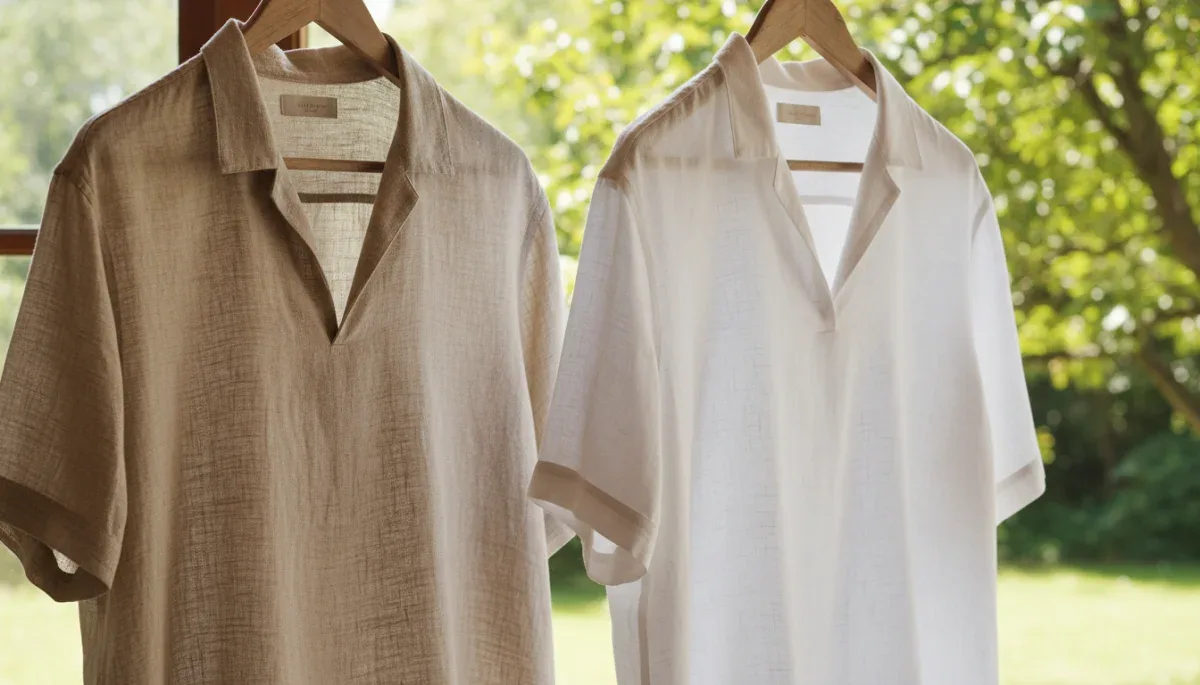
Visual appearance is the most noticeable point of divergence between pure flax and blended options. Pure linen has an architectural quality. It holds defined shapes, points on collars, box pleats, and wide trouser legs with crisp structural integrity. However, it also records every bend of your elbows and hips as sharp, geometric wrinkles. In casual warm-weather styling, this relaxed crumple is accepted as a hallmark of luxury, but in professional office settings, it can read as sloppy if not managed carefully.
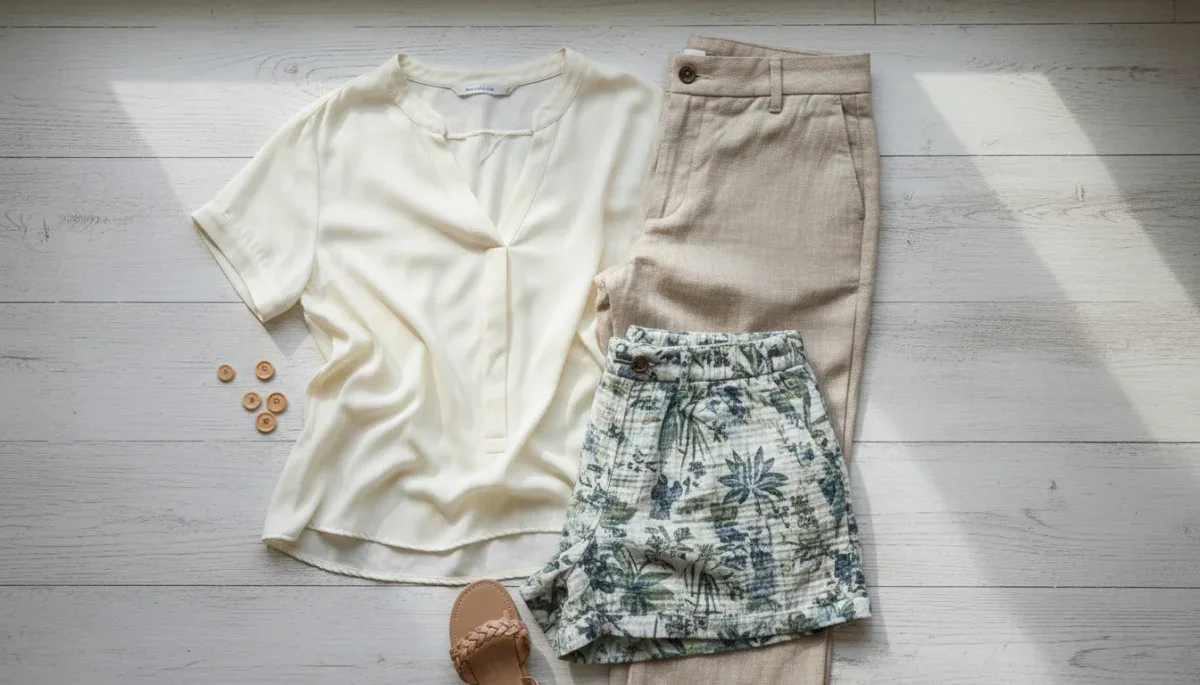
Linen-rayon and linen-viscose blends transform that stiffness into a supple, flowing hand. Rayon fibers lack the structural rigidity of flax, allowing the woven material to fall flat against the body rather than standing proud. While a linen-rayon dress will still develop gentle waves and soft folds during wear, it rarely forms the hard, accordion-style creases seen in pure flax. The fabric looks noticeably dressier at the end of an eight-hour shift without requiring midday ironing.
Linen-cotton blends split the difference between crispness and fluidity. Cotton adds roundness and natural flexibility to the yarn, which prevents the flax fibers from snapping into sharp folds under pressure. The resulting texture looks similar to an Oxford cloth or casual chambray, featuring the subtle, organic nubs of linen alongside the uniform surface of cotton. This balance makes linen-cotton a reliable choice for everyday button-down shirts, tailored shorts, and casual blazers that need to hold clean lines throughout hot afternoons.
Moisture absorption, heat dissipation, and skin comfort
When ambient humidity reaches high levels, skin comfort depends on how quickly clothing absorbs liquid perspiration and transfers body heat away from the skin. Pure linen remains the benchmark for these conditions due to its high moisture absorption capacity and open yarn spacing. Because flax fibers are inherently thicker than cotton or synthetic threads, weavers traditionally use a looser, more open basket or plain weave. This open grid promotes uninhibited ventilation.
Linen blends that incorporate rayon, viscose, or lyocell handle moisture very effectively. Regenerated cellulose fibers possess higher moisture regain rates than standard cotton, drawing sweat rapidly into the fiber core. These blends feel cool to the touch upon first contact, a quality textile specialists call cool hand. However, when saturated by heavy perspiration, rayon can lose significant tensile strength and can cling to wet skin, temporarily obstructing airflow until the fabric dries out in a breeze.
Linen-polyester blends perform poorly in sweltering, un-airconditioned heat. Polyester is hydrophobic, meaning the fiber absorbs less than one percent of its weight in water. When blended with linen, the synthetic fibers repel perspiration rather than pulling it away from your pores, forcing sweat to pool on your skin underneath the clothing. While thin polyester threads can be engineered with open weaves, the synthetic surface does not conduct body heat away with the speed of natural plant cellulose. For dry, desert heat, a linen-polyester shirt might feel tolerable, but in coastal or tropical humidity, pure linen and high-percentage linen-cotton blends deliver substantially better personal cooling.
Durability, washing routines, and shrinkage risks
Pure linen is renowned for longevity. Flax is among the strongest natural fibers known, exhibiting roughly twice the tensile strength of cotton. Furthermore, linen possesses the unusual characteristic of becoming stronger when wet, allowing pure flax garments to endure hundreds of laundry cycles without thinning or fraying. With repeated washing and gentle drying, the stiff pectin binding the flax fibers breaks down, causing one hundred percent linen garments to become progressively softer over years of use.
Care requirements for pure linen are straightforward but require patience. Pure flax shrinks easily if exposed to high mechanical heat. Washing in cold or lukewarm water on a gentle cycle and line drying preserves the dimensions of the garment. Ironing pure linen requires applying steam or pressing while the fabric is still slightly damp, as dry flax wrinkles resist even heavy household irons.
Practical washing considerations across fabric types
- One hundred percent linen: Can handle vigorous washing cycles but shrinks under high dryer heat; softens continuously over its lifespan; demands damp ironing for a completely smooth finish.
- Linen-cotton blends: Highly durable and simple to wash in standard cycles; moderate shrinkage risk; presses flat much more easily than pure flax with a basic steam iron.
- Linen-rayon blends: Requires gentle or delicate machine settings; vulnerable to seam distortion or thread breakage when wet; should never be tumble dried on high heat.
- Linen-polyester blends: Highly resistant to shrinkage and machine abrasion; dries rapidly on a clothesline; melts if touched with a high-heat iron setting.
Linen-rayon and linen-viscose blends require the gentlest treatment in the laundry room. Rayon weakens by roughly thirty to fifty percent when saturated with water, making it prone to snagging, seam pulling, or dimensional distortion if subjected to heavy spin cycles. A linen-rayon summer dress should generally be washed inside a mesh laundry bag or laundered by hand, then laid flat to dry away from direct sunlight to maintain its original silhouette.
Reading online fabric tags when shopping on a budget
Fast-fashion platforms and discount marketplaces frequently categorize garments under linen collections regardless of their true material composition. A product search for linen shirt often yields items made from pure cotton, slub-weave polyester, or minimal blends containing as little as five to ten percent flax. Understanding garment labels is essential for securing the warm-weather performance you expect.
United States federal law, enforced by the Federal Trade Commission through the Textile Fiber Products Identification Act, mandates that all apparel sold to consumers must carry an accurate label disclosing the generic names and percentages by weight of each constituent fiber present in amounts of five percent or greater. Online product detail pages must also reflect this information. Before completing a purchase, scroll down past the marketing imagery to the specifications table or materials tab to verify the exact blend breakdown.
For warm weather wear, aim for garments with at least fifty percent linen content if you want noticeable thermal cooling and natural texture. A fifty-five percent linen and forty-five percent cotton shirt provides substantial flax performance at a fraction of the cost of pure Irish or French linen. Conversely, if a garment lists seventy percent polyester, twenty percent cotton, and ten percent linen, it will perform almost identically to standard synthetic clothing, offering negligible heat relief despite having a slubbed surface texture.
Pay close attention to fabric weight, often listed in product descriptions as light, medium, or given in grams per square meter (GSM). Lightweight pure linen below one hundred and twenty GSM can be somewhat translucent, requiring strategic layering or skin-tone undergarments. Linen-cotton and linen-rayon blends at the same weight are generally more opaque due to the tighter spacing of cotton threads and the smooth uniformity of rayon filaments, making them more practical for unlined summer pants and work dresses.
At a glance
| Fabric option | What to know |
|---|---|
| Pure linen | Offers maximum airflow and heat transfer but wrinkles deeply and requires careful steam ironing. |
| Linen and cotton | Softens the fabric hand and reduces creasing while remaining breathable, durable, and budget friendly. |
| Linen and rayon | Delivers an elegant, fluid drape that resists sharp wrinkles but weakens when soaked in the wash. |
| Linen and polyester | Minimizes wrinkles and lowers garment cost but traps body heat and sweat in humid conditions. |
Frequently asked questions
Does pure linen keep you cooler than a linen blend?
Yes, pure linen keeps you cooler than synthetic blends and slightly cooler than cotton mixes. Flax fibers conduct body heat away quickly and maintain an open weave that promotes cross-ventilation, making pure linen the most effective option when dealing with high ambient humidity.
Why are linen blends cheaper than one hundred percent linen?
Flax processing requires labor-intensive harvesting, retting, and spinning techniques that yield lower textile output than cotton or synthetic manufacturing. Blending flax with less expensive fibers like cotton or mass-produced polyester reduces the total yarn cost, allowing brands to sell garments at lower retail prices.
Do linen blends wrinkle as much as pure linen?
No, linen blends wrinkle significantly less than pure linen. Adding flexible cotton fibers or supple rayon threads rounds out the yarn structure, allowing the woven cloth to bend and recover without forming the sharp, persistent creases characteristic of one hundred percent flax.
Can you machine wash linen blend clothing safely?
Yes, most linen blends can be machine washed on gentle or delicate settings using cold water and mild detergent. However, garments containing rayon or viscose should never be exposed to aggressive spin cycles or tumble dryers, as wet regenerated cellulose fibers tear and distort easily under heat.
The bottom line
Pure linen remains the undisputed champion for ventilation in high summer humidity, but linen blends with cotton or rayon offer a more manageable compromise for daily wear, providing soft drape, fewer hard creases, and lower price tags. If you prioritize easy laundering and a smooth visual drape for work or travel, choose a blend with at least fifty percent linen content. Before buying from any budget clothing site, always check the exact fiber breakdown in the product specifications to confirm you are not paying for mostly synthetic material.
Written by
Lucas Bastos
Lucas Bastos writes about house, clothes and discounts for onlyshein.com. Each article explains how things work, compares published details such as prices, policies and program rules, and points readers to the official source before they decide.